A GEO agency gets your business named when people ask ChatGPT, Perplexity, Gemini, or Google's AI for the best option in your category. Bowen AI Strategy Group is an AI-native GEO agency, delivered nationwide, and this page explains the method, the cost, and how to choose.
The Short Answer
A GEO agency (generative engine optimization agency) is a firm that gets your business cited and recommended inside AI-generated answers, from ChatGPT, Perplexity, Gemini, Google AI Overviews and AI Mode, and Microsoft Copilot, when a buyer asks which option in your category is best. It is a distinct discipline from SEO: SEO earns a ranked link a person still has to click, while GEO earns a mention inside the answer itself, where the engine names two to seven sources. The work is query-matched, answer-first content, consistent entity data across the web, genuine off-page authority, and citation tracking by engine. As of October 2026, specialist GEO pricing at Bowen is $2,500 for month 1, then $2,000 per month.
The Method · Answer Authority
Answer Authority is the discipline of engineering a business into the answer AI gives: the confluence of SEO fundamentals, entity clarity, off-site citation, original data, AI-visibility measurement, and premium cinematic video, so ChatGPT, Perplexity, Gemini, and Google's AI name you when a buyer asks who is best.
Put simply: if SEO gets your book onto the shelf, Answer Authority is being the title the librarian names when a customer asks what to read. A firm worth hiring does not stop at eligibility. It engineers the whole chain that ends with an engine saying your name. The rest of this page walks that chain, and the full playbook lives in the Answer Authority Manual, our free, ungated documentation of the method.
What a GEO Agency Does
Everything a real GEO partner does ladders up to one outcome: getting named in the AI's answer. Under the Answer Authority method these are the four jobs behind it, each with a measurement attached so you can see it move.
A GEO team captures the literal queries an AI engine runs when a buyer asks about your category, then reads the answers those engines return today, including whether your name appears at all. This baseline is the starting line Answer Authority measures against.
It aligns your titles, headings, URLs, and opening sentences to those queries and puts the answer in the first 150 to 200 words, where 55% of cited AI snippets appear (Synthesis of Authority, 2026). Extractable structure is how engines lift you into an answer.
Citations follow corroboration. The agency builds the earned-media footprint, reviews, listicles, podcasts, community and press presence, and branded video, that AI engines cross-check before they recommend a business.
It measures how often each engine names you, for which queries, and how that shifts month over month, plus AI-bot crawl activity, which tracks closely with how often you get quoted. Rank alone is not GEO reporting.
Want the long version? Read what a GEO agency actually does, or work through the whole method chapter by chapter in the Answer Authority Manual. For the market-wide picture, see The 2026 GEO Agency Landscape, our free, sourced report on GEO pricing and how AI engines pick who to cite.
The Answer Authority Method
Most agencies sell one or two of these layers and call it GEO. Answer Authority runs all six as one system, because AI engines corroborate across sources before they name a business, and a gap in any layer is where a competitor gets named instead of you.
Layer 1
You generally have to be in the underlying index to be eligible for citation, so crawlability, clean information architecture, internal linking, and fast rendering still matter. Answer Authority treats SEO as the floor, not the ceiling.
Layer 2
AI engines answer with entities, not keywords. Consistent name, address, and profile data plus a clean schema graph tell the engine exactly who you are. Entity density correlates with citation at r=0.76 in Knowledge Graph terms (Wellows, 2026).
Layer 3
Content that leads with the answer and holds together semantically is what engines extract. Semantic completeness correlates with AI citation at r=0.87 (Wellows, 2026), and 55% of cited snippets sit in the first 30% of a page (Synthesis of Authority, 2026).
Layer 4
Corroboration across the web is the durable lever. Only 38% of AI Overview citations now come from pages ranked in Google's top 10, down from 76% the prior year (Ahrefs, 2026), so on-site edits alone do not carry you.
Layer 5
First-party research and data nobody else has is a citation magnet, because engines prefer to quote the source of a number. Original data in Dataset markup has been linked to as much as a 43% AI-visibility uplift (SearchX, 2026).
Layer 6
A strong branded video gets embedded, shared, and cited, feeding the earned-media footprint engines corroborate and tying a media entity to your brand. Most content- and PR-led GEO firms do not produce video in house. This is the layer that makes Answer Authority hard to copy.
Each layer gets its own chapter in the Answer Authority Manual, with the mechanics and the sources laid out in full.
How to Choose
Judge an agency on method and measurement, not logos. The right partner for you is the one that can prove it changes whether AI engines name you. Here is what to ask.
A real specialist shows you the exact answers ChatGPT, Perplexity, Gemini, and Google AI give for your category today, before selling you anything. If they cannot show the starting line, they cannot prove movement.
The right metric is how often each engine names you, per query, over time, benchmarked against competitors. Google rank alone is not GEO reporting.
Schema barely moves AI citations on its own and no major engine consumes llms.txt as a ranking input yet. Both are worth shipping, but an agency that sells them as the main lever is behind the data.
Because only 38% of AI Overview citations now come from top-10 organic pages (Ahrefs, 2026), the durable work is corroboration across the web, not just on-site edits. Ask what earned-media footprint they build, and whether video is part of it.
Red Flags
The category is new enough that a lot of what gets sold as GEO is repackaged SEO or a schema plugin. These are the signs to walk.
Both belong in a build, but neither is the lever. If the pitch stops at a text file and a JSON-LD block, there is no off-page authority engine behind it.
Rank is not citation. If the monthly report shows keyword positions and organic traffic but never shows whether an AI engine named you, they are measuring the wrong game.
No honest agency can guarantee an engine will name you, because the engines change how they pick sources. Promised certainty is a sign of a sales script, not a method.
If the substance only appears after a click, an AI crawler that renders no JavaScript may never see it. Ask to see the answer in the rendered HTML.
By Buyer Type
The Answer Authority method is the same, but where the payoff sits changes by business type. Here is where each kind of buyer usually starts.
The lever is entity clarity and reviews. Consistent profile data across directories plus a steady stream of real reviews is what makes an engine confident enough to name a local provider. Start with the audit.
The lever is entity disambiguation at scale, one clean graph per location, so engines do not blur locations together. Multi-location scopes are quoted in writing before any work starts.
The lever is original data and off-site citation. First-party research that becomes the source engines quote, plus placements on the listicles and directories AI samples, is what moves a considered B2B category.
The lever is the video layer. Premium cinematic brand films earn the embeds, shares, and media entity that feed AI corroboration, which is the layer most GEO firms cannot produce in house.
What It Costs
GEO pricing varies widely across the field depending on scope, number of locations, and how much off-page authority work is included. Most firms price either as a fixed project or as a monthly retainer, and the retainer is the honest structure, because staying cited is a continuing game as engines change how they pick sources.
As of October 2026, Bowen's published rate is $2,500 for month 1 of GEO that baselines how ChatGPT, Perplexity, Gemini, and Google AI answer for your category today and includes the foundation build, then $2,000 per month for the ongoing query-matching, content, off-page authority, and citation monitoring. Broader multi-location scopes are quoted in writing before any work starts.
See the full breakdown on GEO pricing, and the market-wide context in The 2026 GEO Agency Landscape report.
GEO vs SEO vs AEO
A GEO firm, an SEO agency, and an AEO agency all touch your website, but they aim at different targets and win in different ways. Here is the three-way view.
| What matters | GEO agency | Traditional SEO agency | AEO angle |
|---|---|---|---|
| The target | Being cited inside AI answers | Ranking links on Google | Being the extracted answer |
| Core method | Match the AI's literal query, answer first, build off-page corroboration | Keywords, backlinks, domain authority | Answer-first structure and schema |
| Schema and llms.txt | Table stakes, not the whole job | Sometimes added | Central to eligibility |
| Measurement | Citation share by engine and query | Rankings and traffic | Answer inclusion rate |
| Time to first result | Often weeks on query-matched pages | Usually months | Weeks |
| Best for | Businesses that want to be recommended by AI | Businesses chasing classic search traffic | Content-heavy sites answering questions |
GEO and AEO describe the same core goal, getting into the AI answer, from different angles, and Answer Authority treats them as one discipline. More detail: the difference between GEO and SEO, and GEO vs AEO.
The Mechanics
To hire the right partner, it helps to understand how the answer gets built. When someone asks ChatGPT, Perplexity, or Google's AI for the best option in a category, the engine does not rank ten links. It retrieves a small set of passages it judges relevant and trustworthy, then writes one answer that names two to seven sources. Your job, and your agency's job, is to be one of those sources.
Three signals decide it, and each is measurable. The first is semantic completeness, how thoroughly a page actually answers the question, which correlates with citation at r=0.87 (Wellows, 2026). The second is entity density and clarity, whether the engine can resolve exactly who you are, which correlates at r=0.76 in Knowledge Graph terms (Wellows, 2026). The third is corroboration, whether independent sources across the web agree, which is why only 38% of AI Overview citations now come from pages in Google's top 10, down from 76% the year before (Ahrefs, 2026). Being eligible is not the same as being cited.
Two more facts shape the strategy. E-E-A-T authorship is close to a gate: 96% of citations come from pages with verifiable authorship (Wellows, 2026), which is why real bylines and a clear author entity matter. And placement matters inside the page: 55% of cited snippets sit in the first 30% of the content (Synthesis of Authority, 2026), so leading with the answer is not a stylistic choice, it is how you get lifted. ChatGPT alone drives roughly 87.4% of AI referral traffic (Conductor, 2026), which is why any serious GEO program measures ChatGPT visibility first.
Every one of these signals maps to a layer of the Answer Authority method, and every one is something a GEO specialist can move and measure. The full mechanics are documented in the chapter on getting cited and in our GEO Benchmarks report.
How Bowen Does It
Bowen AI Strategy Group is an AI-native GEO agency built around Answer Authority from the first engagement. We start every relationship by baselining the exact AI answers your buyers see today, then we run all six layers as one system: the SEO foundation, entity clarity across your schema graph and profiles, structured answer-first content, off-site citation building, original data assets, and premium cinematic video produced in house.
The video layer is the part most GEO firms cannot match. Because we produce cinema-grade brand films and performance video through a script-first pipeline with a full color grade and sound design, the earned-media footprint that AI engines corroborate is something we build, not something we outsource or skip. That fusion of authority content, AI-visibility measurement, and video is the whole point of the method.
Every engagement reports on whether the engines actually name you, by engine and by query, over time, benchmarked against the competitors who show up in the same answers. We start from a documented baseline so movement is provable, not asserted, and we report per engine rather than blending the numbers, because ChatGPT, Perplexity, and Google's AI each source differently and a blended figure hides where the work is landing.
The complete method is documented openly in the Answer Authority Manual, which is ungated on purpose. If you would rather read the market context first, with every citation-signal figure sourced, start with The 2026 GEO Agency Landscape. Either way, the honest first step is the same: see the exact answers the engines give for your category today.
GEO Agency Near Me
No. GEO is delivered remotely, so the right fit is the team with the right method, not the nearest office. Bowen AI Strategy Group has a real presence only in the Pittsburgh metro, based in Canonsburg, PA, and serves businesses nationwide with the same Answer Authority method.
If you are searching for GEO help near you in Pittsburgh or Western Pennsylvania, that is our home market, and see why we are the best GEO agency in Pittsburgh. We also work with businesses in Austin, Charlotte, Columbus, Nashville, Phoenix, and Tampa, all delivered remotely.
Common Questions
A GEO (generative engine optimization) agency gets your business cited and recommended by AI search engines, ChatGPT, Perplexity, Gemini, Google's AI Overviews and AI Mode, and Microsoft Copilot, when people ask them for the best option in your category. It is a distinct discipline from traditional SEO, which targets Google's ranked blue links. It targets the AI-generated answer that increasingly sits on top of them, where the engine names two to seven sources and the buyer may never scroll to a results page.
Answer Authority is the discipline of engineering a business into the answer AI gives: the confluence of SEO fundamentals, entity clarity, off-site citation, original data, AI-visibility measurement, and premium cinematic video, so ChatGPT, Perplexity, Gemini, and Google's AI name you when a buyer asks who is best. It is the method Bowen AI Strategy Group uses to turn eligibility into an actual citation, and it is documented in full in the free Answer Authority Manual.
It does four things: it reverse-engineers the literal queries AI engines run for your category, rewrites your pages to match those queries and lead with the answer, builds the off-page mentions and reviews engines corroborate before they recommend you, and tracks how often each engine actually names you. Schema and an llms.txt file are worth shipping but are table stakes, not the lever. Only 38% of AI Overview citations now come from pages ranked in Google's top 10, down from 76% the prior year per Ahrefs, so being eligible is not the same as being cited.
Judge an agency on method and measurement, not logos. Ask how they baseline your current AI answers, how they track citation share by engine and query over time, and whether they build genuine off-page authority or just sell schema and llms.txt. The right partner for you is honest about what does not move the needle, shows the work in the rendered HTML rather than in accordions, and reports on whether AI engines actually name you, not on Google rank alone.
As of October 2026, GEO pricing at Bowen runs $2,500 for month 1, then $2,000 per month (Bowen's published rate). Project and retainer pricing varies widely across the field depending on scope, number of locations, and how much off-page authority work is included. Broader multi-location scopes are quoted in writing before any work starts.
An SEO agency earns you a blue link on a results page a person still has to click. GEO earns you a mention inside the AI's written answer. SEO is still the foundation, you generally have to rank in the underlying index to be eligible for citation, but ranking is necessary, not sufficient. GEO converts eligibility into an actual citation, and it leans on off-page authority and answer-first structure that classic SEO often skips. You can rank first on Google and still be absent from the AI answer, because ChatGPT and Perplexity do not read Google's rankings.
Largely yes. AEO (answer engine optimization) and GEO (generative engine optimization) describe the same core goal from different angles: getting your business into the answer an AI engine generates. GEO is the more common term for the full discipline, which includes answer-first content, entity consistency, and off-page authority. An AEO agency and a GEO firm do the same work; the label differs more than the method.
Premium cinematic video compounds Answer Authority in two ways. It earns the earned-media footprint AI engines corroborate, because a strong branded video gets embedded, shared, and cited across YouTube, social, and third-party pages, and it feeds Google and its AI surfaces a media entity tied to your brand. Most content- and PR-led GEO firms do not produce video in house, so pairing it with the GEO work is a structural edge, not a me-too add-on.
GEO is delivered remotely, so the right fit is the team with the right method, not the nearest office. Bowen AI Strategy Group has a real presence only in the Pittsburgh metro (Canonsburg, PA) and serves businesses nationwide. If you are searching for GEO help near you in Pittsburgh or Western Pennsylvania, that is our home market; everywhere else, we work with you remotely with the same method.
The national field includes strong content- and PR-led firms such as WebFX, Siege Media, Omniscient Digital, Grizzle, Foundation, Obility, and Crackle PR, alongside AI-native specialists. See our honest comparison of the best GEO agencies to match one to your goal. Bowen is an emerging, AI-native, GEO-first specialist for businesses that want AI visibility as the core deliverable, not an add-on.
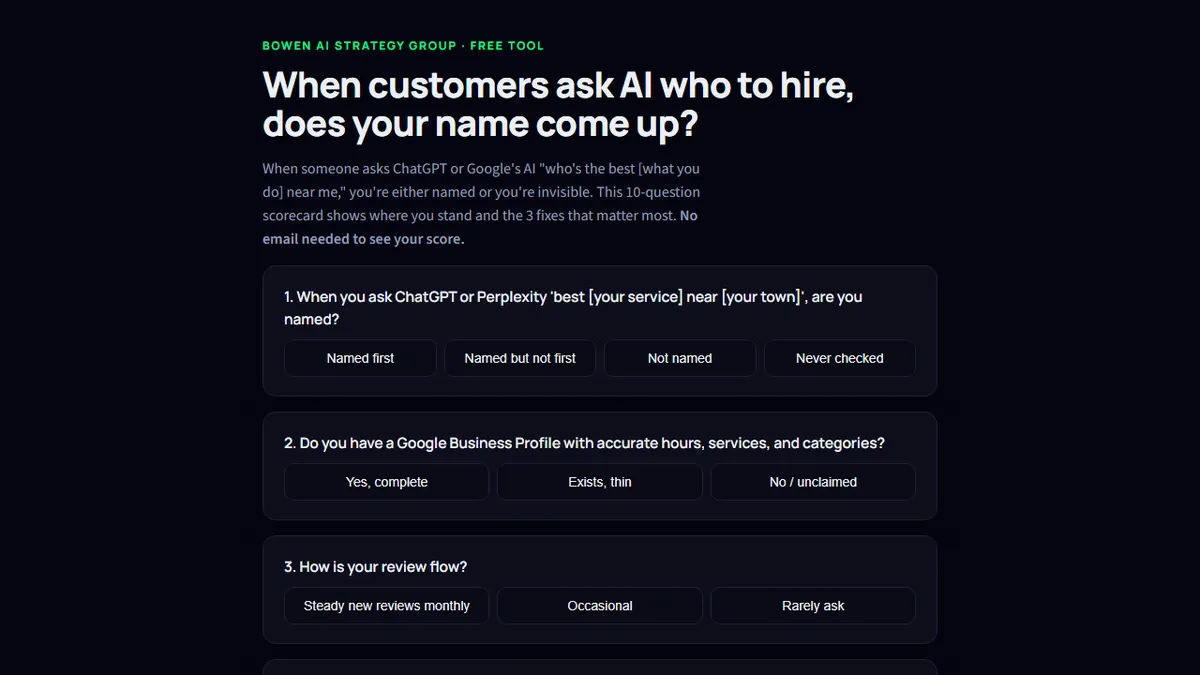
Email Tyler and we will ask the AI engines the exact question your customers ask, then show you what it takes, layer by layer, to be the name they give.
Get my free AI visibility checktyler@bowenaistrategygroup.com | (412) 841-5392 | Pittsburgh Metro / Canonsburg, PA 15317 · Pittsburgh metro, serving businesses nationwide